

Last updated: 10 October 2026. Terminal allocations, fares and port rules are changing over 2026–2028; check the details in your cruise documents before you travel.
Barcelona is one of the busiest cruise ports in Europe, with more than 3.6 million cruise passengers in 2024. Yet the Barcelona cruise terminals are not where most first-time visitors expect them to be. Nearly all large ships now dock on a long breakwater about 3 km from the foot of La Rambla, which you cannot sensibly walk with luggage. This guide explains where each terminal is, which cruise lines use them, how to get to and from the city, and what is changing at the port over the next few years.
It is written for both kinds of cruise passenger: those starting or finishing their cruise in Barcelona, who need to move luggage between the airport, a hotel and the ship, and those on a port day, who simply want to get into the city and back before all-aboard time.
Barcelona cruise terminals at a glance
| Terminal | Where | Mainly used by | Status |
|---|---|---|---|
| A, B and C | Moll Adossat | Many lines; shared public terminals | C closes for demolition from the end of 2026; A and B from 2028 |
| D (Palacruceros) | Moll Adossat | Carnival Corporation brands | Open |
| E (Helix) | Moll Adossat | Carnival Corporation brands | Open |
| H | Moll Adossat | MSC Cruises | Opened in 2025 |
| G | Moll Adossat | Royal Caribbean Group | Under construction, due 2027 |
| WTC Sud | Moll de Barcelona, near the Columbus monument | Smaller ships | Closes to cruise ships at the end of 2026 |
Lines are not tied to one terminal forever: the port allocates berths for each call, and the same ship can use different terminals on different dates. Your cruise documents or the cruise line app will name the terminal a few days before sailing; that is the information to trust.
Where the Barcelona cruise terminals are
Moll Adossat is the breakwater on the south side of the port, beyond the Porta d’Europa lifting bridge. Terminals A, B and C sit closest to the city, and D, E and H further out. From Terminal A, walking to the Columbus monument takes about 25 minutes; from Terminal D it takes around 45 minutes, along a busy road with no shade and no shops. With suitcases, or in the summer heat, it is not a realistic option.
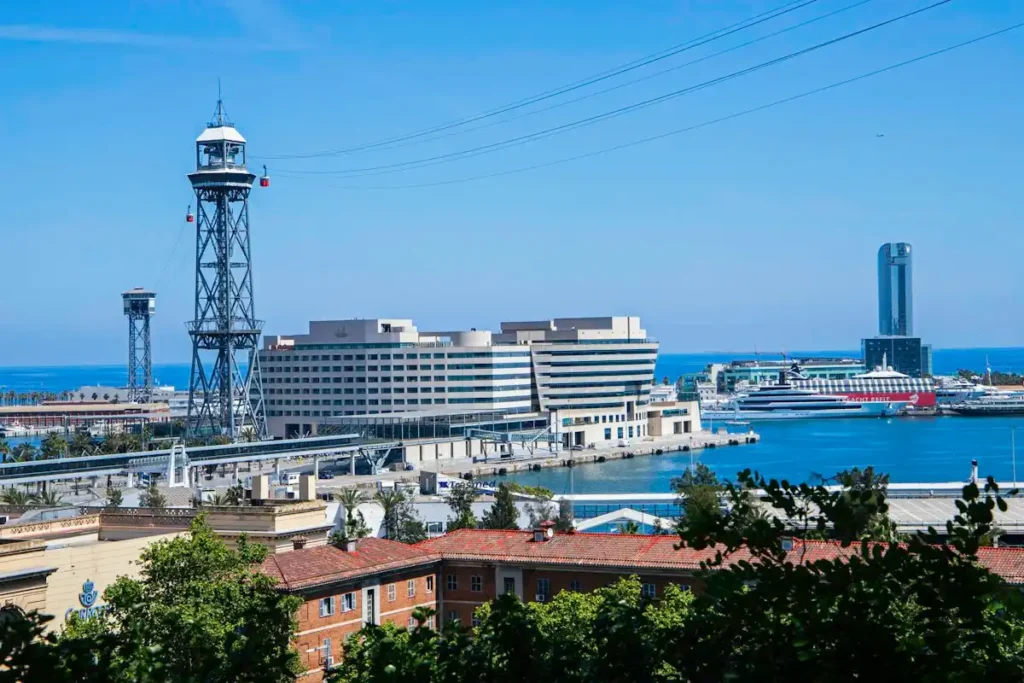
The World Trade Center terminals on Moll de Barcelona are in a different league for location: the Columbus monument, La Rambla and the Drassanes metro station are a 5–10 minute walk away. Only smaller ships use them, and the last of them, WTC Sud, is due to stop receiving cruise ships at the end of 2026.
Getting from the Barcelona cruise terminals into the city
The Cruise Bus (T3) is the port’s own shuttle and the cheapest way off Moll Adossat. It runs between the terminals and a stop next to the World Trade Center and the Torre Jaume I cable car tower, about 400–500 metres from the Columbus monument.
- Fare: €3.50 one way or €5 for a day return; pay by card on board or buy online.
- Frequency: about every 20 minutes, and more often when ships are arriving or leaving.
- Journey time: around 10 minutes, plus queuing on busy mornings when several ships are in port.
Taxis wait at ranks outside every terminal. In 2026 a €4.60 supplement applies to trips that start or end at Moll Adossat, on top of the meter. Expect about €15 to the Columbus monument or Plaça de Catalunya, and €15–20 to the Sagrada Família, outside rush hour. A standard taxi takes four passengers and a reasonable amount of luggage.
The metro does not reach the terminals. The nearest station, Drassanes on line L3, is about 600 metres from the Cruise Bus stop, and from there a T-casual ticket covers onward trips around the city.
A pre-booked driver meets you at the terminal exit and takes you straight to your hotel, the airport or the start of a tour, at a price agreed in advance per vehicle. If that suits your group, see our Barcelona cruise port transfer page.
Embarkation day: getting to the ship
If your cruise starts in Barcelona, the cruise line will give you a check-in time slot. Arriving much earlier rarely helps: the Barcelona cruise terminals have limited seating, and you cannot drop luggage before the check-in window opens.
- From the airport: there is no direct public transport to Moll Adossat. Taxis charge a fixed €46 between the airport and the Moll Adossat terminals (2026 tariff), the journey takes 20–30 minutes, and cruise lines sell their own transfers. By public transport, you would need the Aerobús to Plaça d’Espanya and then a taxi.
- From a city hotel: a taxi takes 10–25 minutes depending on where you are staying. Taxis can be scarce on Saturday and Sunday mornings, the busiest changeover days, so book ahead or allow extra time. Our guide on where to stay in Barcelona before a cruise compares the best areas.
- Flying in on the same day: plan to land at least four to five hours before the ship’s departure, and earlier if your flight comes from outside the Schengen area and you face passport control.
If you are flying into Barcelona first, our guide to the Barcelona airport terminals explains which terminal your airline uses and how long the arrival process takes.
Disembarkation day: getting off and onwards
On the last morning, ships usually disembark between about 07:00 and 10:00 in groups. If several ships turn around on the same day, the taxi queues at Moll Adossat can be long, especially between 08:00 and 10:00.
- Flights: book a flight that leaves after midday, or later if you want time in the city.
- Luggage: the Barcelona cruise terminals do not store luggage. Left-luggage shops near the Columbus monument charge around €5–6.50 per bag per day, and some services collect bags from the terminal for a fee.
- Self-disembarkation: if you can carry all your own luggage, walking off early is usually the quickest way to beat the taxi queue.
- Pre-booked transport: a driver waiting at the terminal exit avoids the queue entirely, which matters most with children, older relatives or a lot of luggage.
On a port day: time ashore
Transit calls in Barcelona usually last between eight and eleven hours, which leaves enough time for one or two major sights but not for wandering without a plan. Build in a buffer: aim to be back at the Cruise Bus stop at least 60–90 minutes before all-aboard time, because the return queue can be long in the late afternoon. Our Barcelona port day guide has three self-guided plans with timings.
Keep a photocopy of your passport and your cruise card with you, carry a card for the Cruise Bus, and note the ship’s terminal letter before you leave: it is the first thing the bus or taxi driver will ask. For guided options that fit your hours ashore, see our Barcelona shore excursions.
Inside the Barcelona cruise terminals
The terminals are functional rather than comfortable. Expect a large check-in hall with airline-style desks, security screening, toilets and a seating area, but few places to eat. Some terminals have a small café or vending machines; none has the shops or restaurants of an airport. If you are travelling with children or have a long wait, bring water and snacks.
- Wi-Fi: usually available in the check-in halls, but it can be slow when a full ship is checking in.
- Accessibility: the terminals have step-free access, lifts and accessible toilets. Tell your cruise line in advance if you need a wheelchair from the terminal entrance to the ship.
- Adapted taxis: wheelchair-accessible taxis can be booked through the AMB taxi service or local apps; they are not always waiting at the rank.
- Cash machines and currency: do not count on finding one at the terminal. Withdraw cash in the city if you need it.
The cruise passenger tax
Cruise passengers who stay in Barcelona for less than 12 hours pay a municipal tourist tax in addition to the Catalan tourist tax. You do not pay it in cash: it is charged by the cruise line and normally included in the port charges. In 2026 the city council approved raising the municipal part for these short calls to €24 per passenger; the change still has to complete its approval process, and local media expect it to apply from April 2027. Passengers who start or finish their cruise in Barcelona do not pay this short-stay tax; if they spend a night in the city, the standard hotel tourist tax applies instead.
What is changing at the port
In 2025 the city council and the Port of Barcelona signed an agreement to reduce the number of Barcelona cruise terminals from seven to five and to concentrate cruise traffic on Moll Adossat, away from the city centre. In practice, this means:
- WTC Sud, the last terminal by the Columbus monument, stops receiving cruise ships at the end of 2026.
- Terminal C is due to be demolished from the end of 2026, followed by Terminals A and B from 2028.
- A new terminal is planned on the same site, opening in phases from around 2028.
- Royal Caribbean’s new terminal is due to open in 2027.
For passengers, the main effect is that almost every cruise will start, end or call at Moll Adossat, so the Cruise Bus, taxis or a pre-booked driver will be the only practical ways in and out.
Frequently asked questions
Can you walk from the cruise port to La Rambla?
From the World Trade Center terminals, yes, in about 10 minutes. From Moll Adossat it takes 25–45 minutes along an unshaded road, so most passengers use the Cruise Bus or a taxi.
How much is the Cruise Bus in Barcelona?
The Cruise Bus (T3) costs €3.50 one way or €5 for a day return. It runs about every 20 minutes and takes around 10 minutes.
How much is a taxi from Barcelona airport to the cruise terminals?
Taxis charge a fixed €46 between the airport and the Moll Adossat terminals under the 2026 tariff, including supplements.
Is there luggage storage at the Barcelona cruise terminals?
No. Use a left-luggage shop near the Columbus monument, or a service that collects bags from the terminal.
Which terminal does MSC use in Barcelona?
MSC Cruises uses its own terminal, Terminal H, on Moll Adossat, which opened in 2025.
Official sources
Check the Port of Barcelona website for terminal information and daily cruise calls, and the AMB taxi service for current taxi tariffs.
Want a driver waiting at the terminal?
Send us your ship, date and destination on WhatsApp. We reply with a fixed price per vehicle, and there is nothing to pay in advance.