

Last updated: 10 October 2026. Prices are the official 2026 rates; always check availability and any closures on the park’s official website before you go.
Park Güell tickets are the one thing you cannot leave to the last minute in Barcelona. Gaudí’s hillside park is free to wander in most of its area, but the famous part, with the mosaic dragon, the serpentine bench and the gingerbread gatehouses, is a ticketed Monumental Zone with a strict limit on visitors per half hour. In high season, the best morning slots sell out days in advance.
This guide explains what the ticket includes, current prices, how the timed slots work, which entrance to use and how to get up the hill without exhausting yourself. It also covers the best time of day for photos, how long to allow and whether the combined ticket with the Gaudí House Museum is worth it.
Park Güell tickets at a glance
| Ticket (2026) | Adult | Ages 7–12 and 65+ | Under 7 |
|---|---|---|---|
| Monumental Zone | €18 | €13.50 | Free, but needs a ticket |
| Monumental Zone + Gaudí House Museum | €24 | €19.50 | Free, but needs a ticket |
| Official guided tour | See official site | Reduced rates available | See official site |
Tickets are sold online only, for a specific date and time slot, and are personal and non-transferable. Buy them on the park’s official website; resale platforms charge more and do not add anything you need.
What the Monumental Zone includes
Park Güell was commissioned by the industrialist Eusebi Güell as a garden city for wealthy families. Gaudí worked on it from 1900 to 1914, but only two houses were ever sold, and the city turned it into a public park in 1926. Today it is one of the seven Gaudí works on the UNESCO World Heritage list. Your ticket covers the core of the original project:
- The main entrance and gatehouses: two pavilions with mushroom-like roofs on Carrer d’Olot. One of them, the Casa del Guarda, houses a small exhibition on the park’s history.
- The Dragon Stairway: the double staircase guarded by the multicoloured mosaic salamander, the park’s best-known photo spot.
- The Hypostyle Room: a forest of 86 Doric columns, built as a market hall, with mosaic medallions on the ceiling.
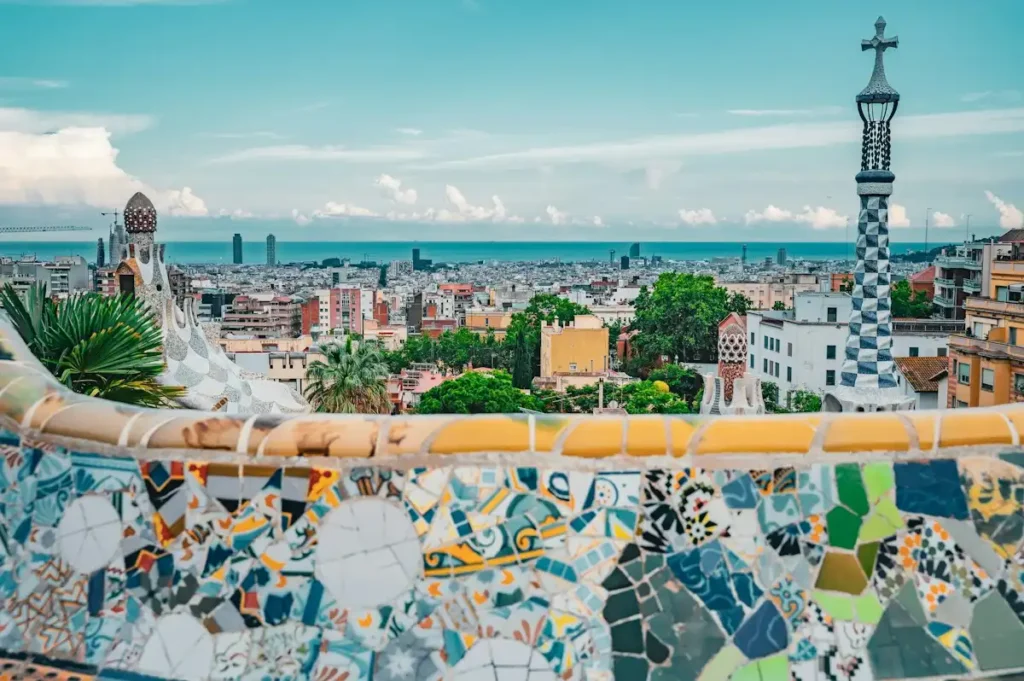
- Nature Square: the large terrace above, edged by the serpentine bench covered in broken-tile mosaic, or trencadís, much of it by Gaudí’s collaborator Josep Maria Jujol.
- The Laundry Room Portico and the viaducts: leaning stone colonnades that look as if they grew out of the hillside.
How Park Güell tickets work: time slots and entry rules
- Choose a 30-minute slot. You can enter at any time within half an hour of the start of your slot. Arrive later and you may be refused, with no refund.
- Stay as long as you like. Once inside, there is no time limit, though most visitors spend 60–90 minutes in the Monumental Zone.
- Bring the ticket on your phone and be ready to show ID if you have a reduced ticket.
- Opening hours vary through the year, typically from 09:30 (earlier in high summer) until early evening. There is no longer any free entry to the Monumental Zone at dawn or dusk.
- Closures: the park sometimes closes in high winds or heavy rain for safety. If that happens, check the official site for rebooking options.
How far ahead to book Park Güell tickets
As a guide, book three to five days ahead in spring and autumn and one to two weeks ahead from June to August, at Easter and over Christmas. During the 2026 Gaudí centenary year, demand has been higher than usual, so book as soon as your dates are fixed. The 10:00–13:00 slots go first; the first slot of the morning and the last ones of the afternoon stay available longest, and they are also the most pleasant times to visit.
The best time to visit
Early morning is quietest and coolest, and the low sun picks out the colours of the mosaics. Late afternoon brings warm light over the city and the sea from Nature Square, which is ideal for photos but busier. Avoid midday in summer: there is little shade on the terrace, and the paths are steep. On rainy days the mosaics shine, but the stone paths can be slippery.
Getting to Park Güell
The park sits on the slopes of Carmel hill, above the Gràcia district. Every route involves some climbing, so choose the one that matches your energy and your entrance.
- Taxi: the easiest option. Ask to be dropped at the entrance on Carretera del Carmel or at the main gate on Carrer d’Olot. From the city centre the ride takes 15–25 minutes.
- Bus: line 24 from Plaça de Catalunya and Passeig de Gràcia stops close to the Carretera del Carmel entrance, the flattest approach.
- Metro: from Lesseps or Vallcarca on line L3, it is a 15–20 minute uphill walk. From Vallcarca, outdoor escalators on Baixada de la Glòria do much of the climbing for you.
- Hop-on hop-off buses: stop nearby, but leave you with a walk uphill.
If you are combining the park with the Sagrada Família on the same day, allow about 20 minutes by taxi between the two.
Which entrance to use
Your ticket is valid at any of the Monumental Zone access points, but they lead to different parts of the visit.
- Carrer d’Olot (main entrance): the classic arrival, with the gatehouses and the Dragon Stairway straight ahead. Expect a queue at peak times.
- Carretera del Carmel: the most practical for bus 24 and taxis, with a gentler walk.
- Passatge de Sant Josep de la Muntanya: the side approach from the Vallcarca escalators.
Is the Gaudí House Museum worth adding?
The pink house with a spire inside the park was Gaudí’s home from 1906 to 1925. After a restoration it reopened as a museum showing furniture he designed for Casa Calvet and Casa Batlló, personal objects and his private rooms. It is sold only as a combined ticket with the Monumental Zone, for an extra €6, and takes 30–40 minutes. It is worthwhile for Gaudí enthusiasts; on a tight schedule, the time is better spent in the park itself.
The free part of the park
Outside the Monumental Zone, most of Park Güell is a free public park with pine woods, stone paths and viewpoints. The best is the Turó de les Tres Creus, a stone mound topped with three crosses at the highest point, with a sweeping view over the city to the sea. It is a steep climb, but free and open to everyone. If you cannot get a ticket, the free area still gives you a feel for Gaudí’s landscape design.
Tips for a smooth visit
- Book Park Güell tickets for the first or last slot for fewer people and better light.
- Wear comfortable shoes: the paths are steep, unpaved in places and dusty in summer.
- Bring water and sun protection from May to September; shade is limited.
- Watch your belongings at the Dragon Stairway and on the terrace, where crowds attract pickpockets.
- Ignore street sellers offering “skip-the-line” tickets outside the gates; only official tickets are valid.
- Plan your exit: taxis are easiest to find on Carretera del Carmel or Travessera de Dalt.
Park Güell tickets or a guided tour?
A standard ticket and a good audio guide or app are enough for most visitors: the park is compact and the highlights are easy to find. A guide adds the stories you would otherwise miss, from the symbolism of the dragon to why the garden city failed, and handles the timing for you. The park runs its own guided tours in English, Catalan and Spanish, which can be booked with the ticket. Families with curious children and architecture lovers tend to get the most out of a guide.
Make an afternoon of Gràcia
Park Güell sits above Gràcia, a former village swallowed by the city that still feels like a small town. After your visit, walk or take a short taxi ride down to its squares, such as Plaça del Sol and Plaça de la Virreina, for lunch or a drink. Gaudí’s first house, the striking Casa Vicens, is also in Gràcia, ten minutes’ walk from Lesseps metro, and makes a quieter second visit.
Accessibility
Park Güell is built on a hillside, with steps, slopes and uneven ground, so it is one of the more difficult Gaudí sites for visitors with reduced mobility. The park offers an adapted route and can lend two wheelchairs on request; the Carretera del Carmel entrance is the most suitable. Arriving by car or taxi, and planning a short, focused visit, makes a big difference.
Park Güell in a wider plan
Most visitors combine the park with the Sagrada Família and Passeig de Gràcia, which makes a full but rewarding Gaudí day. Our guide to Barcelona in one day shows how to fit it in. If you would rather have a driver take you up the hill and wait while you visit, see our Barcelona private tours; Park Güell is part of our full-day and Gaudí itineraries.
Frequently asked questions
How much are Park Güell tickets in 2026?
€18 for adults and €13.50 for children aged 7–12 and visitors over 65. Under-7s go free but still need a ticket. The combined ticket with the Gaudí House Museum costs €24.
Can you buy Park Güell tickets at the entrance?
No. Tickets are sold online only, by time slot, and popular slots sell out in advance.
Is Park Güell free?
Most of the park is free, but the Monumental Zone, with the dragon, the serpentine bench and the Hypostyle Room, requires a paid ticket.
How long do you need at Park Güell?
Allow 60–90 minutes for the Monumental Zone, plus 30–40 minutes for the Gaudí House Museum and extra time if you climb to the Three Crosses viewpoint.
What happens if I arrive late for my slot?
You can enter up to 30 minutes after the start of your slot. After that, entry is not guaranteed and tickets are not refunded.
Official sources
Buy Park Güell tickets and check opening times, closures and accessibility information on the official Park Güell website. For transport routes, see TMB.
Want Park Güell without the climb?
Tell us your date and hotel on WhatsApp. Your driver takes you to the gate, waits while you visit and continues the day with you, at a fixed price per vehicle.